Introduction
The lighting on the street is an essential component of modern cities. As a result, the cities require reliable lighting poles for roads, highways, parks and public areas.
Nonetheless, manufacture of street light poles involves some metalworking processes. Cutting, bending, forming, welding, straightening and surface treatment processes.
A Street Light Pole Production Line combines the processes as a complete street light pole manufacturing system.
Consequently, this enables manufacturers to enhance production efficiency and ensure uniformity in pole quality.
There are various pole constructs which modern production lines also accommodate. For instance, you can manufacture conical poles, octagonal poles, polygonal poles as well as custom lighting structures.
As a result, the appropriate production equipment can directly affect manufacturing speed and product quality.
Metalworking machinery and custom production line solutions for industrial manufacturers by Nanjing Bangwin Machine.
Visit the official website:
What is a Street Light Pole Production Line?
Street Light Pole Production Line is a set of equipment which use sheet metal or steel plates to manufacture the lighting poles.
Generally, the production process begins with steel plate preparation.
Then manufacturers cut the plates into the necessary sizes.
Then you have the forming machines, which bend those plates into the shape of poles.
Next, the edges are welded together with welding machines.
Finally, the manufacturers then straighten, finish and inspect the finished poles.
A full production line can have:
- Plate shearing machine
- Plate cutting machine
- Plate bending machine
- Trapezoid plate shearing machine
- Hydraulic forming machine
- Pole welding machine
- Straightening machine
- Pole head bending machine
- Pipe head shrinking machine
- Grinding equipment
- Galvanizing equipment
This more natural method of production means manufacturers can arrange the production line based on their product array.
Street Light Pole Manufacturing Process
The process of manufacturing is a lengthy one that often consists of several stages.
Step 1: Steel Plate Preparation
First the manufacturer prepares appropriate steel plates.
Some of the common materials are carbon steel, galvanized steel.
The material selection depends on:
- Pole height
- Wind load
- Wall thickness
- Application environment
- Customer requirements
This is why having good material preparation lays the groundwork for good production.
Step 2: Plate Cutting
The next option is to cut the steel plate.
Used for shearing most shapes suitable for forming into poles, a Plate Trapezoid Shearing Machine can shear plates more quickly than ever.
To get the precise dimensions for cutting
Otherwise, the pole geometry at the end may be incorrect if dimensions are not set.
Thus, manufacturers should rely on high-precision cutting equipment.
Step 3: Plate Bending
The steel plate is then processed through the bending process after cutting.
The flat plate is successively molded into a polygonal or conical shape by the machine.
Manufacturers may use: Depending on the pole design;.
- Hydraulic press brakes
- Plate rolling machines
- Pole forming machines
For a given pole geometry and thickness of the material it is impossible to say which one will be the correct forming method.
Step 4: Pole Forming
Final cross-sectional shape comes from pole forming.
For example, manufacturers can produce:
- Octagonal poles
- Conical poles
- Polygonal poles
- Round poles
Hydraulic forming system can give high static and uniform forming pressure.
Step 5: Longitudinal Welding
The edges need to be welded post forming.
Longitudinal welding of the pole seam.
Automatic welding decreases human activities and increases uniformity.
Then, it is suitable for mass production.
Step 6: Pole Straightening
There is a small amount of deformation due to welding and folding.
This is why most manufacturers use a straightening process after welding。
The machine corrects:
- Bending
- Local deformation
- Angular deviation
This step enhances both the aesthetic look of the final product and its dimensional accuracy.
Step 7: Pole Head Processing
Special head structure is needed for some street light poles.
A Pole Head Bending Machine is used by manufacturers for particular designs.
For example some other applications require a Pipe Head Shrinking Machine.
These machines assist in creating accurate pole connections.
Step 8: Grinding and Finishing
Manufacturers eliminate the inconsistencies caused by these welds.
Such an improvement ensures the surface finish as well, which gives importance to grinding machines.
This makes the pole prepared for an additional layer of surface treatment.
Step 9: Surface Treatment
Corrosion Protection of Street Light Poles
Common treatments include:
- Hot-dip galvanizing
- Powder coating
- Painting
Surface treatment improves durability.
It also acts as a protection from outdoor environmental conditions for poles.
Step 10: Quality Inspection
Manufacturers then check the poles at the end.
Inspection can include:
- Dimensions
- Straightness
- Weld quality
- Surface condition
- Flange dimensions
Thus, final inspection ensures reliable product quality.
Main Components in Street Light Pole Production Line
Technical Street Light Pole Production Line can be composed of four or more professional machines as below.
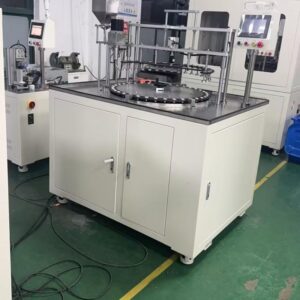
Plate Trapezoid Shearing Machine
This machine slices steel plates into appropriate shapes.
You are encouraged to efficiently prepare for pole forming.
Plate Trapezoid Shearing Machine
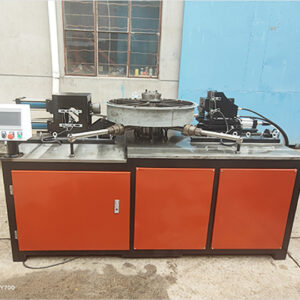
Hydraulic Axial Forming Machine
This one shapes plates to the pole geometry.
It offers regulated hydraulic pressure throughout the forming process.
Horizontal Hydraulic Axial Forming Machine
Pole Head Bending Machine
The stick by itself experience as well as only the resulting top section of pole is processed using this gadget.
Through this, it aids the manufacturers in making various formats of lighting poles.
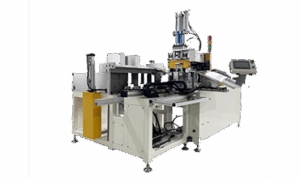
Pipe Head Shrinking Machine
This is a shrinking machine that allows you to select several sections of pipe that are machined to a diameter.
Thus it is capable for pole connection designs of special purposes.
Pipe Head Shrinking Machine
Automatic Welding Machine
Longitudinal seams are made with automatic welding equipment
It can enhance the speed of production and welding, too.
Automatic Welding Machine
Straightening Machine
The straightening machine is used for deformation correction after forming and welding.
Hence, it is better for final pole geometry.
Automatic Production Line for Street Light Poles
Automatic Street Light Pole Production Line is designed to lessen the workload.
It can integrate:
- Automatic plate feeding
- Automated positioning
- Hydraulic forming
- Automatic welding
- Straightening
- Material handling
- Quality inspection
With it, manufacturers can maximize their production efficiency.
Automation also reduces operator dependence.
Also, automatic machinery delivers more consistent processing conditions.
An advantage that is crucial for large-scale production.
Benefits of Automation
Higher Productivity
Automatic machines reduce processing time.
Thus, manufacturers can boost daily production.
Better Consistency
Automation maintains stable processing parameters.
This improves product uniformity.
Lower Labor Requirements
Automated systems reduce repetitive manual operations.
Therefore, manufacturers can optimize labor costs.
Improved Safety
Using automation means less direct operator contact with heavy steel plates.
Easier Production Management
Modern machines allow integration of digital controls.
Hence, it allows manufacturers to monitor the critical parameters of production.
Applications of the Street Light Pole Production Line
Many infrastructure projects are being supported on street light poles.
Urban Roads
The poles are made to handle the elements they will face on streets and thoroughfares.
As a result, stable production systems are required from the manufacturers side.
Highways
And highways provide perhaps even taller, more robust lighting structures.
The production line can produce poles of various heights and wall thicknesses.
Parking Areas
Medium-height lighting poles are typically found in parking lots.
There are various mounting configurations available for manufacturers.
Parks and Public Areas
Custom Designs: Decorative lighting poles often require custom designs.
Hence, flexible forming equipment offers a lot of advantages.
Solar Street Lights
Solar lighting systems must have poles that support solar collection and lighting equipment.
Such applicatzions need bespoke structures, whice can be ade from the productin line.
Making the Right Choice for Street Light Pole Production Line
Here are a few things that manufacturers need to think about before buying any equipment.
Production Capacity
The first step is to figure out your annual, or even monthly, anticipated turnover.
More automation equals higher industrial output.
Pole Specifications
Consider:
- Pole height
- Base diameter
- Top diameter
- Wall thickness
- Pole shape
- Flange dimensions
These specifications determine machine requirements.
Material Thickness
Forming force increases with increasing thickness of the steel.
Thus, the material range should match machine capacity.
Automation Requirements
Semi-automatic equipment is probably more popular with small factories.
Most of the bigger manufacturers will favour integrative solutions.
Factory Space
In order for the production line to accomodate, it should have a reasonable amout of space allocated for:
- Material storage
- Cutting
- Forming
- Welding
- Straightening
- Finished product handling
Thus, prior to purchasing tools, manufacturers should plan out the factory layout.
Why Choose Nanjing Bangwin Machine?
Nanjing Bangwin Machine Nanjing Bangwin MachineIndustrial Machinery and Customized production solutions
The company develops practical manufacturing equipment for metalworking and production applications.
Official website:
For example the following equipment is needed for making street light poles:
- Plate Trapezoid Shearing Machine
- Hydraulic Axial Forming Machine
- Pole Head Bending Machine
- Pipe Head Shrinking Machine
- Automatic Welding Machine
- Straightening Machine
Nanjing Bangwin Machine are also able to choose the appropriate equipment for customers according to production requirements.
As a result, the manufacturers can create a system of production that is catered to their production capacity and product specifications.
Home
FAQ
- What is a Street Light Pole Production Line?
A Street Light Pole Production Line combines cutting, forming, welding, straightening, and finishing equipment.
- What machines are needed to manufacture street light poles?
Typical equipment includes shearing machines, forming machines, welding machines, straightening machines, and surface treatment equipment.
- What materials can street light poles use?
Manufacturers commonly use carbon steel and galvanized steel.
Material selection depends on design and environmental requirements.
- Can the production line manufacture different pole shapes?
Yes. Suitable forming equipment can produce conical, octagonal, polygonal, and other pole designs.
- Is an automatic production line better?
An automatic line can improve productivity and consistency.
However, the best configuration depends on production volume and budget.
- Can Nanjing Bangwin Machine customize the production line?
Yes. Manufacturers can select equipment according to pole dimensions, material thickness, production capacity, and factory requirements.
Conclusion
A Street Light Pole Production Line is a systematic process that encompasses various metalworking operations.
Processes introduced include plate cutting, forming, welding, straightening machining and inspection.
Automation will also enhance productivity and product uniformity.
Equipment Suitability – before making any purchases of equipment, manufacturers should evaluate pole specifications, production capacity for a specific product line, material thickness and length restrictions, level of automation required to meet demand requirements for the factory floor space available.
Nanjing Bangwin Machine is specialized in machinery and solutions for the production sectors of metal processing.
For more information on industrial production equipment: