1. Introduction to Vapor Chamber Machine Factory
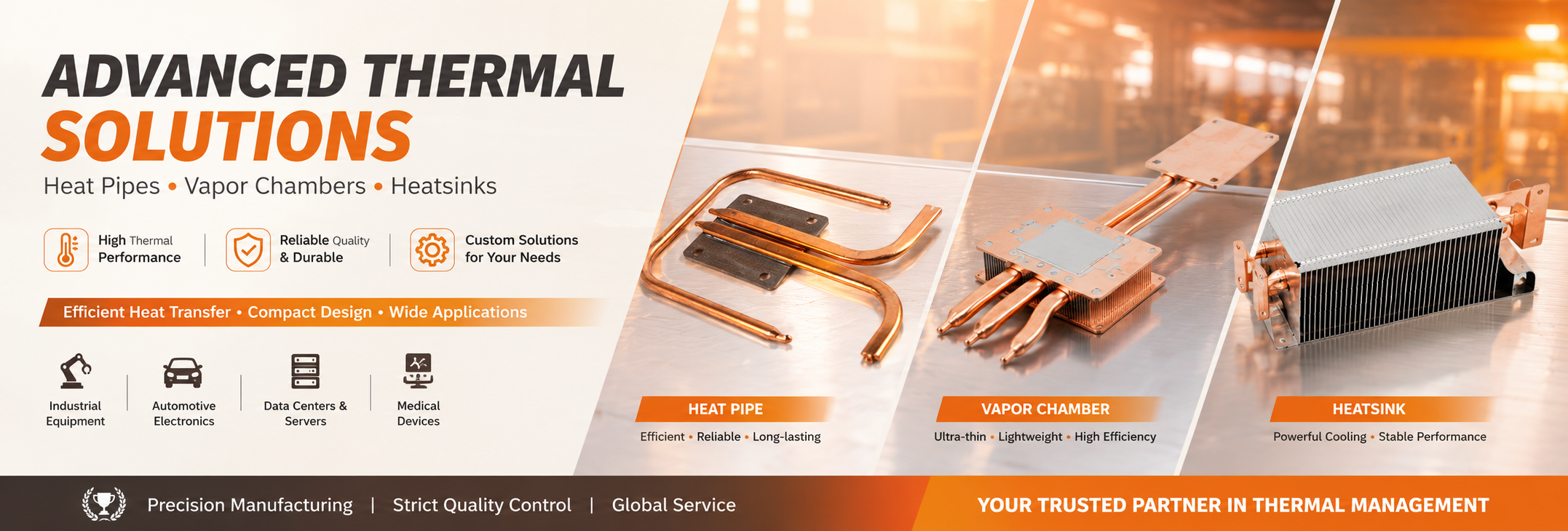
A vapor chamber machine factory is a company that specializes in designing, manufacturing, assembling, and testing vapor chamber production equipment.
Since vapor chambers involve many precision manufacturing processes, the quality of production equipment has a major impact on efficiency and product performance.
Proficient vapor chamber machine factories can offer custom single machines or full production-line solutions to meet your needs.
The equipment can include, but is not limited to:
- Copper sheet preparation equipment
- Chamber forming machine
- Wick structure manufacturing equipment
- Cleaning machine
- Vapor chamber assembly equipment
- Working fluid filling machine
- Vacuum pumping machine
- Degassing equipment
- Laser sealing machine
- Hot press machine/flattening machine
- Thermal performance testing machine
Additionally, an experienced vapor chamber machine factory can help seamlessly merge each process into one unified production line.
Internal Link: Vapor Chamber Production Line
2. Types of Machines Produced by Vapor Chamber Machine Factory
Typically, a full vapor chamber manufacturing machine system will consist of several different types of equipment.
Each machine has its own unique purpose in the overall manufacturing process.
Machine | Main Function |
Forming Machine | Shapes copper chamber components |
Wick Manufacturing Equipment | Produces the internal capillary structure |
Cleaning Machine | Removes oil, particles, and contaminants |
Assembly Equipment | Combines chamber components |
Fluid Filling Machine | Adds the required working fluid |
Vacuum Pumping Machine | Removes air and non-condensable gases |
Degassing Equipment | Improves internal vacuum conditions |
Laser Sealing Machine | Seals the chamber |
Hot Press Machine | Controls final thickness and flatness |
Testing Equipment | Evaluates thermal and sealing performance |
Different vapor chamber designs and sizes may require unique equipment solutions.
For instance, thin vapor chambers used in smartphones may have different forming equipment and hot pressing requirements than larger vapor chamber cooling plates.
3. Vapor Chamber Manufacturing Process
In order to understand the function of each machine, it helps to review the basic vapor chamber manufacturing process.
A vapor chamber is a sealed plate that uses phase change heat transfer to spread heat.
Like a heat sink, it absorbs heat at the hot spot and disperses it across the entire surface.
The manufacturing process for vapor chambers includes the following steps:
Step 1: Copper Material Preparation
Cut copper sheets/plates to proper size as specified by product dimensions. Sheet thickness must be consistent.
Step 2: Chamber Forming
Vapor chamber machine used to form upper and lower components of chamber.
Product dimensions must be accurate.
Step 3: Wick Structure Manufacturing
The wick allows for condensed liquid to return to the heat source. Many vapor chambers use sintered copper powder wicks.
Step 4: Cleaning
All components should be thoroughly cleaned before assembly.
Surfaces should be contaminant free to improve assembly bonding and seal integrity.
Step 5: Assembly
Position chamber components and wick structure together.
Alignment is critical during this step, especially with thin vapor chambers.
Step 6: Working Fluid Filling
Fill with proper working fluid as specified by product design. Proper fill amount is crucial.
Step 7: Vacuum Pumping and Degassing
Remove all unwanted gases from inside vapor chamber.
Degassing improves vacuum conditions within vapor chamber.
Step 8: Sealing
Port where vapor chamber was filled should be properly sealed.
Laser can be used to provide localized heat to seal port.
Step 9: Hot Pressing
Last step in many vapor chamber production lines.
Flattening ensures final thickness and flatness is uniform and meets specs.
Step 10: Testing
Vapor chamber manufacturers will usually test for correct dimensions, seal integrity, internal vacuum level, and thermal performance.
Vapor Chamber Manufacturing Process
4. Vapor Chamber Forming Equipment
The forming equipment is used to construct the base structure of the vapor chamber.
The dimensions created from this step will play a huge role in the finished vapor chamber.
A vapor chamber forming machine should provide:
- Precision forming
- Stable pressure during process
- Consistent dimensions batch after batch
- Compatible tooling options
- Rapid cycle time
- Easy adjustments to forming parameters
Producing vapor chambers with repeatable dimensions is crucial for mass production.
If one vapor chamber is even slightly out of spec, it can have noticeable effects on thermal performance.
A reputable vapor chamber machine factory should have a good grasp on both vapor chamber machine design and your product specifications.
5. Wick Structure Manufacturing Equipment
The wick is arguably the most crucial component inside a vapor chamber.
Not only does it transport liquid back to the heat source, but the wick structure heavily influences thermal performance.
In most high-performance vapor chambers, copper powder is sintered to create the wick structure.
Controlling copper powder distribution as well as sintering parameters becomes very important.
Other aspects to consider include:
- Wick thickness
- Total porosity
- Sintering temperature
- Sintering time
Structural uniformity is important for ideal wick performance as well.
A proper sintering machine can help ensure each wick has consistent properties.
Automated powder distribution and sintering can help with production consistency for high-volume orders.
6. Cleaning and Assembly Equipment
Cleaning may not seem like the most important step in vapor chamber production, but it is wrong.
Oil residue, dust, particles, and other contaminants can cause issues with vapor chamber internals.
For this reason, many vapor chamber production lines will have specialized vapor chamber cleaning equipment.
Once the components are cleaned, they will be brought to an assembly station.
The vapor chamber assembly equipment should minimize human error as well as part contamination.
Alignment is also important during this stage of production.
7. Vacuum Pumping and Degassing Equipment
A strong vacuum is required inside the vapor chamber for proper heat transfer.
Vacuum pumping machines remove air and other unwanted gases from inside the vapor chamber.
Dependent on your process, things like moisture should also be removed.
- Air
- Non-condensable gases
- Process residuals
Typical features of a vacuum pumping machine include:
- Steady pumping rate
- Quick pumping times
- Adjustable parameters
For a production line, vacuum levels should be consistent between each vapor chamber produced.
Most automated systems will record the vacuum data for each individual unit.
Vapor Chamber Vacuum Pumping Machine
8. Laser Sealing Equipment
Once the vapor chamber is filled and pumped, you need to ensure the port is sealed.
Laser sealing is ideal for vapor chambers because it can provide a large amount of energy to a small area.
If your vapor chamber is small or has a small filling port, laser sealing is a good option.
Some key points to look for in a laser sealing machine:
- Power output
- Welding speed
- Positioning
- Welding path
- Copper thickness
- Heat affected area
Each of these parameters should be adjusted based on your chamber design.
An experienced vapor chamber machine factory will know what sealing technology to use based on the chamber dimensions.
For large scale production, automatic laser positioning and seam inspection can ensure consistency and quality.
Vapor Chamber Laser Sealing Machine
9. Hot Press and Flattening Equipment
Since vapor chambers require a specific thickness, they normally go through a hot pressing process.
A hot press/flattening machine can ensure thickness and flatness are within your specifications.
Specifications that are often controlled during this process:
- Pressing force
- Temperature
- Holding time
- Thickness
- Flatness
This is an important step for thin vapor chambers.
Smaller products like smartphone heat spreaders have less internal depth.
Product designers have to balance thermal performance with physical size.
Vapor Chamber Hot Press Hydraulic Machine
10. Vapor Chamber Testing Equipment
Product quality cannot be assured by production equipment alone.
Testing equipment is also critical.
Common inspection parameters include:
Dimensional Inspection
Typical measurement factors include:
- Length
- Width
- Thickness
- Flatness
- Port Dimensions
Leakage Testing
Leakage tests verify sealed chamber integrity.
Vacuum Inspection
Vacuum factors can also indicate quality of internal processing.
Thermal Performance Testing
Thermal testing measures a vapor chamber’s heat-transfer ability.
Appearance Inspection
Surface defects, deformation, contamination, and weld quality are other considerations.
For factories with integrated automation, testing results can tie into production data records. This allows for maximum traceability and process optimization.
11. Automatic Vapor Chamber Production Lines
An automatic vapor chamber production line strings multiple machines together to form one cohesive manufacturing system.
Instead of physically transferring components between processes, each step is coordinated through automation.
One typical production line might look like:
Material Preparation → Forming → Wick Processing → Cleaning → Assembly → Filling → Vacuuming → Degassing → Laser Sealing → Hot Pressing → Testing
Automation offers several benefits:
Eliminates manual transportation of goods.
Provides more consistent processing.
Can reduce production cycles.
Coupled data collection makes it easier to isolate process problems.
Automatic production lines can also scale to different production volumes.
One factory may start out with semi-automatic equipment,
then upgrade individual processes to full automation as production demand increases.
Automatic Vapor Chamber Production Line
12. How to Choose a Vapor Chamber Machine Factory
Engineers cannot simply compare equipment catalogs when selecting a factory.
There are many important factors to consider.
12.1 Manufacturing Experience
First and foremost, you want to work with a supplier who knows vapor chamber production.
It’s not enough to know how each machine works.
The supplier should understand how each process impacts the final product.
12.2 Equipment Customization
Since vapor chambers come in all different sizes and structures,
off-the-shelf machines will likely need some adjustments.
Ask the factory if they can customize:
- Tooling
- Machine Dimensions
- Process Parameters
- Automation Levels
- Production Capacity
- Testing Systems
12.3 Production Capacity
Think about how much vapor chamber you want to produce.
Maybe you’re just starting a small pilot production run.
All you might need are a few individual machines.
But if you need to manufacture hundreds of thousands of units per year,
you’ll probably want an entire automatic production line.
12.4 Process Integration
A reputable factory should also understand how individual machines integrate into the larger production process.
For instance: forming tolerance levels will impact sealing.
Wick quality will impact thermal performance.
Vacuum level will impact heat transfer efficiency.
Process integration should be considered when connecting multiple machines.
12.5 After-Sales Support
Installing new equipment is only one portion of a production project.
Don’t forget about:
- Installation
- Commissioning
- Operator training
- Process adjustment
- Troubleshooting
- Maintenance & Spare Parts
- Ongoing Technical Support
These value-added services can greatly reduce your time to production.
13. Why Production-Line Integration Matters
Purchasing machines from multiple vendors can lead to compatibility issues.
Every machine has its own control system, interface, and process parameters.
As a result, it can be difficult to integrate everything.
A factory that specializes in vapor chamber machines can design their equipment around your production process.
Benefits of production-line equipment include:
Better Process Coordination
Smarter communication between machines.
Improved Production Flow
Transportation of materials becomes more streamlined.
Easier Maintenance
Operators can use a single dashboard to monitor the entire production line.
Better Data Collection
Access to data from each stage of production.
Futureproofing
The production line is built with expansion in mind.
That’s why manufacturers should buy into the production process, not just one machine.
14. Applications of Vapor Chamber Manufacturing Equipment
As heat-spreading technology becomes more prevalent, vapor chambers are being used in a variety of applications.
Here are some common uses:
Smartphones
Thin vapor chambers can efficiently spread heat in small form factors.
Gaming Laptops
Powerful laptop CPUs and GPUs generate tons of heat.
VD chambers can push that heat to larger heat sinks or cooling fans.
GPUs
GPU heat-flux densities require aggressive heat-spreading solutions.
VD chambers are being considered for next-generation graphics cards.
Data Centers
Server CPUs and GPUs are also affected by high heat-flux densities.
VD chambers can help improve heat dissipation in these high-power devices.
Communication Equipment
Cell phone base stations, routers, and switches can benefit from vapor chamber integration.
Automotive Electronics
Power electronics in EV’s & PHEVs produce a lot of heat.
VD chambers can help improve thermal management & reliability.
LED Systems
High-power LEDs require efficient heat spreaders too.
15. Why Choose Nanjing Bangwin Machine?
At Nanjing Bangwin Machine, we specialize in industrial machinery and customized production lines.
When it comes to vapor chamber manufacturing equipment,
we like to view every project through the lens of production.
Whether it’s small batches or large-scale automation,
our factory can plan your project around your product design,
manufacturing process, desired automation level, and target capacity.
Your project may include:
- Production Process Consultation
- Individual Machines
- Vacuum Equipment
- Filling Machines
- Sealing Equipment
- Hot Pressing Machine
- Testing Machines
- Production-Line Solution
- Installation & Commissioning
- After-Sales Technical Support
Bangwin is the ideal partner when a customer is looking for more than just one standalone machine.
Visit Nanjing Bangwin Machine for more vapor chamber project information.
Home
16. Frequently Asked Questions
1. What machines are found in a vapor chamber machine factory?
Ans. A vapor chamber machine factory is equipped to form, clean, assemble, fill, vacuum, seal, press, and test vapor chambers. Factories can provide individual machines or a fully integrated production line.
2. Can vapor chamber machine factories provide a complete set of vapor chamber production line?
Ans. Yes. A vapor chamber machine factory can provide individual machines for each step of vapor chamber production. Many factories also provide fully integrated production lines.
3. What is the most important machine used in vapor chamber manufacturing?
Ans. Each machine along the production line is important to the overall product quality. From initial forming to the final test, every step is critical to manufacturing high-quality vapor chambers.
4. Can vapor chamber machines be customized?
Ans. Yes. Machine specifications can be customized by chamber size, thickness, structure, production volume, and automation requirements.
5. Why is vacuum processing important?
Ans. Vacuum processing evacuates any unwanted gases from inside the vapor chamber. This ensures optimal performance during phase change heat transfer.
6. Why would I use laser sealing on vapor chambers?
Ans. Laser sealing allows for concentrated, easily controlled heat. This makes lasers ideal for sealing small copper chambers.
7. What should I look for when choosing a vapor chamber machine supplier?
Ans. Before choosing a vapor chamber machine supplier, consider their manufacturing experience, customization capabilities, production capacity, process knowledge, level of automation, testing equipment, installation support, and after-sales technical support.
8. Can one vapor chamber production line produce multiple vapor chamber sizes?
Ans. In most cases, yes. But keep in mind that tooling and processing parameters will change when producing different vapor chamber sizes. A production line should be designed with production variation in mind.
9. Is an automatic production line better than purchasing individual machines?
Ans. Not necessarily. Individual machines are great for low-volume or flexible production. Full automation is better suited for larger production requirements.
17. Conclusion
Don’t simply buy a vapor chamber machine. Buy a solution.
A quality vapor chamber machine supplier should understand your production process from start to finish.
Look for suppliers that connect forming, wick processing, cleaning, assembly, filling, vacuum processing, sealing, hot pressing, and testing.
Also remember that buying into a full production line can increase production consistency.
When planning for new vapor chamber production capabilities, start with your products requirements.
From there, let the vapor chamber machine factory work with you to customize individual machines and the overall automation level.
Nanjing Bangwin Machine is here to provide value-minded manufacturers with smart production solutions.