1. Introduction: What is a Vapor Chamber?
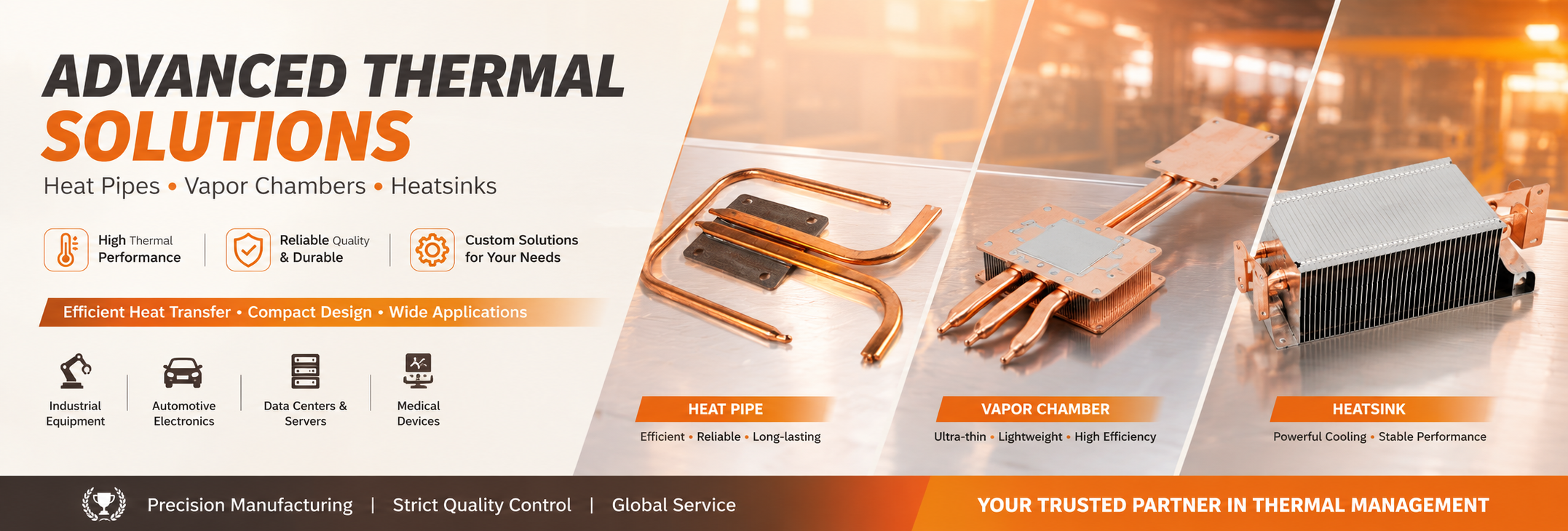
Vapor chambers are often described as flat heat pipes.
They use two-phase heat transfer to efficiently spread heat.
The evaporative process occurs on the hot side of the heat spreading device.
The condensation process releases heat on the cold side.
Copper is the most popular vapor chamber material.
Heat pipes are made with copper due to its high thermal conductivity.
Vapor chambers are built with an internal vacuum.
A small amount of working fluid is placed inside of the heat pipe.
The internal chamber absorbs heat and causes the fluid to evaporate.
Vapor flows toward the cold-side and condenses, releasing heat.
The condensed fluid then returns to heat source via a wick structure.
As a result, vapor chambers can spread large amounts of heat over a small area.
Electronic components have limited space for cooling solutions.
Vapor chambers can replace bulky heat sinks in tight spaces. Here are some common applications:
- CPUs
- GPUs
- Gaming laptops
- Smartphones
- LED lighting
- Telecom equipment
- Power electronics
- Automotive electronics
- High-performance computing
Electronic devices continue to shrink as technology advances.
Therefore, vapor chamber manufacturers continue to see increased demand.
To meet demand, manufacturers need reliable vapor chamber production methods.
2. Why do Vapor Chamber Production Methods Matter?
Small defects can negatively impact vapor chamber thermal performance.
For example, if the chamber isn’t cleaned properly, residues may remain on internal surfaces.
Air and other impurities can limit heat transfer if not removed during vacuuming.
Inconsistent fluid filling can create variability from one chamber to the next.
Poor sealing creates high leak rates which can cause failure.
To ensure thermal performance and reliability, vapor chamber manufacturers should closely monitor production.
A consistent vapor chamber production process should create vapor chambers with:
- Uniform dimensions
- Clean internal surfaces
- Consistent wick structures
- Correct amount of fill
- Reliable vacuum levels
- Uniform sealing
- Low leakage rates
- Consistent thermal performance
Automation helps ensure precision and consistency across all production stages.
In addition, automation can reduce labor requirements and human error.
3. Vapor Chamber Production Process Overview
The complete vapor chamber manufacturing process typically includes these basic stages:
Copper Material → Forming → Cleaning → Wick Manufacturing → Assembly → Fluid Filling → Vacuuming → Sealing → Flattening → Testing
Many different variables can alter the exact production method needed.
For example, some vapor chambers are extremely thin. Ultra-thin vapor chambers require tighter dimensional tolerances.
Large vapor chambers may need stronger forming equipment to create the base shape.
The following is a typical vapor chamber production workflow.
Stage Main Purpose
Material preparation Prepare copper sheets
Forming Create chamber geometry
Cleaning Remove contaminants
Wick manufacturing Create liquid return structure
Assembly Join chamber components
Filling Add working fluid
Vacuuming Remove non-condensable gases
Sealing Close the chamber
Flattening Achieve final thickness
Testing Verify performance and reliability
Each production stage impacts the overall quality of the final product.
4. Step 1: Prepare Copper Material
The main body of a vapor chamber is typically made from copper sheets.
There are many different types of copper materials manufacturers can use.
Each vapor chamber has unique thermal and mechanical requirements.
Copper provides high thermal conductivity and can be formed into shape.
During the material preparation stage, manufacturers should inspect the copper material.
Thickness, surface condition, dimensions, and overall cleanliness should be checked.
Next, manufacturers should cut the copper into the desired sizes.
Dimensional accuracy is critical, so material should be cut precisely.
Automated material handling systems can improve efficiency for large volumes of material.
Finally, manufacturers should ensure copper material is properly stored before use.
Copper can gather dust, oil, and other contaminants during storage.
Clean storage conditions will reduce the time needed for the cleaning process.
Copper Heat Pipe Manufacturing
5. Step 2: Vapor Chamber Forming
The next step is to form the copper plates into shape.
The forming process is what creates the vapor chamber cavity.
Many different methods can be used for this process. Here are some common forming technologies:
- Hydraulic pressing
- Stamping
- Etching
- CNC machining
- Chemical processing
Again, the best method depends on your vapor chamber design.
If you are planning to mass produce vapor chambers, hydraulic forming is a great option.
A hydraulic forming system allows for very consistent results.
Plus, you can ensure consistent thickness if using a precision forming system.
Excessive deformation can ruin the copper material. Therefore, pressure and stroke length must be precisely controlled.
Some manufacturers will use multiple forming processes to create their vapor chambers.
6. Step 3: Surface Cleaning
Surface cleaning is one of the most important steps in vapor chamber manufacturing.
Oil, oxide, dust, and other residues can affect how components bond.
Leftover contaminants can also impact how fluid travels inside of the heat pipe.
Surface cleaning may include the following processes:
- Degreasing
- Washing
- Rinse
- Dry
- Surface inspection
Many vapor chamber production lines include ultrasonic cleaning.
Some vapor chamber manufacturers use chemical cleaning processes.
Your material and production requirements will determine the best cleaning method.
Just remember that after cleaning, you want to minimize copper surface exposure.
If left exposed for too long, your copper surfaces will quickly collect contaminants.
That is why many manufacturers connect the cleaning process directly to assembly.
7. Step 4: Manufacture Wick Structure
The wick structure allows liquid to return to the heat source.
It plays a vital role in the liquid circulation process.
Therefore, the wick structure can impact thermal performance.
There are three common wick structures:
Sintered Powder Wick
Small copper powder is used to form a porous structure.
This porous structure creates capillary force to allow liquid circulation.
Sintered wick structures can achieve strong thermal performance.
They are also used in many electronic cooling applications.
Mesh Wick
A fine copper mesh is used to create the liquid return pathway.
This wick structure is fairly straightforward. However, the mesh characteristics are crucial to performance.
Grooved Wick
These wicks have machined or formed grooves to help circulate liquid.
Grooved wicks provide a relatively simplistic internal structure.
However, the grooves must be tailored to your specific applications needs.
Different vapor chamber designs require different wick structures.
Vapor Chamber Production Equipment
8. Step 5: Vapor Chamber Assembly
Once you have prepared all of the necessary components, it is time to assemble.
The assembly stage will align the top plate, bottom plate, and wick structure.
Proper alignment is important. Poor alignment creates irregular internal space.
You can use fixtures or automated assembly equipment to ensure precision.
Automated equipment can also ensure consistent alignment from one unit to the next.
Some vapor chamber assembly lines also include pre-bonding at this stage.
There are many ways to bond your vapor chamber. The following are common methods:
- Welding
- Brazing
- Sintering
- Diffusion bonding
- Mechanical forming
Your production volume and vapor chamber design will determine the best method for your application.
9. Step 6: Working Fluid Fill
All vapor chambers require working fluid.
Typically, water is used to transfer heat in electronics applications.
However, the working fluid can vary based on your heat pipe’s operating temperature.
The fill quantity also needs to be controlled during this process.
Too much fill will decrease your vapor chamber’s effective vapor space.
Not enough fill will limit your liquid circulation capabilities.
Automated filling machines can ensure the correct amount of fill every time.
You can also control fill speed, fill pressure, fill temperature, and fill sequence.
To ensure reliability, you should also prevent contamination during filling.
Using clean fluid and clean filling equipment will help ensure product reliability.
10. Step 7: Vacuuming and Degassing
Vacuuming is one of the most crucial stages of vapor chamber production.
During this stage, the manufacturer removes non-condensable gases.
Air and other gases inside of the heat pipe reduce thermal performance.
Therefore, it is critical to create a controlled vacuum inside of the vapor chamber.
Typical Vacuum Process: Connection → Vacuum Pumping → Degassing → Vacuum Stabilization → Fluid Management
The vacuum system should be able to reach the desired vacuum level every time.
The vacuum system should also be reliable during long production runs.
High-quality Vapor Chamber Vacuum Machine will help ensure consistency and reliability.
Automated vacuum systems are ideal for high-volume production.
11. Step 8: Vapor Chamber Sealing
Once vacuumed and filled with working fluid, vapor chambers must be sealed by manufacturers.
Sealing keeps air from entering the internal cavity.
Sealing also keeps working fluid from leaking out.
Various vapor chamber sealing technologies are available today including:
- Laser welding
- TIG welding
- Resistance welding
- Brazing
- Mechanical sealing
Laser welding allows for controlled energy input during the weld process.
It can also create small and accurate weld zones.
For this reason, laser sealing is now widely used for advanced vapor chamber production.
Vapor Chamber Laser Sealing Machine
Manufacturers can buy a fully automatic laser sealing system.
Such systems can integrate positioning, laser welding, monitoring, and inspection functions into one machine.
12. Step 9: Flattening and Shaping
After sealing, vapor chambers may need flattening.
Flattening brings the thickness to the correct final value.
Thickness consistency is especially important for thin vapor chambers.
Manufacturers typically use hydraulic pressing machines for this step.
However, the pressing process must not damage the chamber.
Too much force can deform internal structures.
Manufacturers should control parameters such as:
- Pressing force
- Pressing speed
- Stroke
- Tool geometry
- Final thickness
When done correctly, flattening improves dimensional consistency.
Vapor Chamber Hot Press Hydraulic Machine
13. Step 10: Performance Testing
Final inspection and testing ensures that each vapor chamber works properly.
Performing several tests can verify that design requirements are met.
Leak Testing
Leak testing ensures good sealing quality.
This test can expose microscopic leaks.
Thickness Testing
Measuring thickness ensures proper dimensions.
Thickness testing is vital for ultra-thin vapor chamber products.
Thermal Performance Testing
Thermal testing confirms heat spreading performance.
During testing, manufacturers can measure thermal resistance values.
Vacuum Testing
Vacuum inspection ensures stable internal pressure levels.
Visual Inspection
Inspectors will check for visible issues on surfaces.
They may examine weld quality, dimensions, and more.
Automated visual inspection can increase production consistency.
14. Automation in Vapor Chamber Manufacturing
Automation can benefit all aspects of vapor chamber manufacturing.
Production lines can connect multiple machines together.
Material feeding, forming, cleaning, wick processing, assembly, filling, vacuum pumping, laser sealing, pressing and testing can all be automated.
There are many benefits to automation. Firstly, it reduces manual tasks.
Secondly, it creates more consistent processing.
Thirdly, it allows manufacturers to produce more vapor chambers.
Additionally, automated production lines can record process data.
Such data allows manufacturers to track production quality.
As a result, automation is ideal for large volume production of vapor chambers.
15. Vapor Chamber Manufacturing Equipment
Complete vapor chamber production lines use a variety of machines.
The following list details common equipment used in vapor chamber manufacturing.
Note that the required machines depend on your exact product design.
Copper Sheet Cutting Equipment
A copper sheet cutter prepares copper material.
Dimensions are cut to uniform sizes before forming takes place.
Forming Machine
The forming machine is used to create vapor chamber geometry.
Wick Production Equipment
Specialized equipment is used to create the desired porous or structured wick.
Cleaning Equipment
Cleaning machines remove any surface contamination.
Powder Sintering Equipment
Powder sintering machines are used when producing copper powder wicks.
Fluid Filling Machine
Working fluid is carefully filled into the vapor chamber using special filling equipment.
Vacuum Pumping System
The pumping system evacuates any unwanted gases.
Laser Sealing Machine
A laser sealing machine seals the vapor chamber with precise welding energy.
Hot Press Hydraulic Machine
A hydraulic pressing machine creates uniform thickness.
Testing Equipment
Finally, testing machines can be used to evaluate vapor chambers.
Performance testing can include checking for leakage, measuring dimensions, and checking thermal performance.
All of these machines can be connected to create a complete production line.
Vapor Chamber Manufacturing Production Line
16. Quality Control
Every stage of vapor chamber production should be monitored for quality.
Performing 100% inspection at the end of the production line is not enough.
Instead, manufacturers should track important parameters during production.
Parameters that can affect product quality include:
- Copper thickness
- Surface cleanliness
- Wick porosity
- Wick thickness
- Vapor chamber dimensions
- Fluid capacity
- Vacuum level
- Weld quality
- Final thickness
- Thermal resistance
When manufacturers monitor the production process, they can identify issues sooner.
As a result, manufacturers can throw away less scrap and improve yield.
Establishing a system for traceable production records is also beneficial.
This is ideal for large scale vapor chamber production.
Manufacturers can use these records to continually improve their production process.
17. How to Improve Production Efficiency
Production efficiency can be improved in a number of ways.
Use Automatic Material Feeding Systems
Automated material feeding minimizes manual operations.
Plus, it creates a steady production pace.
Combine Vacuum Pump and Fluid Filling Machine
Connecting your vacuum pump to your filling machine can save time.
It can also increase consistency between the two processes.
Use Automatic Laser Sealing
Automatic laser sealing allows for accurate weld control.
Additionally, it creates repeatable production results.
Ensure a Clean Production Environment
A clean production environment will minimize the risk of contamination.
Record and monitor process data
Monitoring data in real-time allows manufacturers to spot issues.
Optimize the layout of your production line
Minimize the distance that products need to travel between machines.
Reducing material movement can improve overall efficiency on the production line.
18. Choosing a Vapor Chamber Production Line
Picking the right production line takes time and planning.
Firstly, know what kind of vapor chamber you want to produce.
What are the dimensions? What thickness? What material? What kind of wick? What working fluid?
Secondly, know how many vapor chambers you want to produce.
Small batches may require more versatile machinery.
High volume production will likely need higher levels of automation.
Equipment integration is another important factor to consider.
Each machine on the production line should work together with the others.
Other factors to keep in mind when choosing equipment:
- Equipment accuracy
- Level of automation
- Production output
- Equipment maintenance requirements
- Energy usage
- Quality control measures
- Technical support from manufacturer
- Ability to expand production line later
As you can see, there are many things to consider when choosing vapor chamber manufacturing equipment.
Keep the overall production process in mind at all times.
19. Why Choose Nanjing Bangwin Machine?
Working with an experienced vapor chamber equipment supplier can help streamline the production line development process.
Nanjing Bangwin Machine specializes in industrial manufacturing equipment and production lines.
We are able to assist our customers with equipment selection and production line planning.
Nanjing Bangwin provides vapor chamber manufacturing solutions that cover key processes.
These include vacuum processing, filling machines, laser sealing machines, pressing machines, and more.
If you are looking to develop vapor chamber production capabilities.
Equipment compatibility is critical to your success.
Nanjing Bangwin ensures that all machines in a production line can work together seamlessly.
A well thought out vapor chamber production line will improve production efficiency and product consistency.
Visit Bangwin’s website to learn more about our equipment and vapor chamber production solutions:
20. FAQ
- What is involved in the vapor chamber manufacturing process?
The vapor chamber manufacturing process typically includes material cutting, forming, cleaning, wick processing, assembly, fluid filling, vacuum pumping, sealing, flattening, and testing.
- What material is used to make vapor chambers?
Copper is the most popular material. Copper has high thermal conductivity and can be processed in different ways.
- Why must vapor chambers be evacuated?
Vapor chambers are evacuated to remove air and other non-condensable gases from inside the cavity. These gases degrade thermal performance by inhibiting evaporation and condensation.
- What working fluid is used inside a vapor chamber?
Water can be used in many electronics cooling applications.
The working fluid you use depends on your operating temperatures and product requirements.
- What does the wick do in a vapor chamber?
The wick transports condensed liquid from the cold regions of the vapor chamber. It returns liquid to the heat source by capillary action.
- How important is laser sealing?
Laser sealing is important because lasers can be precisely controlled.
A laser produces a small and consistent weld seam.
Laser sealing is used on many thin vapor chamber designs.
- What machines are used to manufacture vapor chambers?
Machines used in vapor chamber production include but are not limited to: vapor chamber forming machines, cleaning machines, wick processing machines, filling machines, vacuum pumps, laser sealing machines, hot press machines, and testing machines.
- Can vapor chamber production be automated?
Yes. Material feeding, forming, fluid filling, vacuum pumping, laser sealing, pressing, and testing can all be automated.
Automating your vapor chamber production line can increase consistency and efficiency.
- How can I ensure high quality vapor chambers are produced?
Pay attention to critical aspects of the vapor chamber production process.
This includes surface cleanliness, wick structure, working fluid quantity, vacuum level, sealing quality, and final thickness.
21. Conclusion
Now that you know the Vapor Chamber Manufacturing Process, you should have a better idea of what goes into making vapor chambers.
Each stage of the vapor chamber production process is important for final thermal performance and reliability.
Proper material preparation, forming, assembly, wick structure, vacuum degree, working fluid choice, sealing quality, and flattening will produce high quality vapor chambers.
Material preparation begins the manufacturing process.
The forming process creates the vapor chamber.
Wick structure enables liquid to circulate within the vapor chamber.
Vacuum processing removes unwanted gases.
Filling machines add working fluid to vapor chambers.
The sealing process creates a closed thermal system.
Performance testing ensures each vapor chamber meets design specifications.
Demand for vapor chambers will only increase as electronics trend smaller and more powerful.
Demand for automation and process control will increase as well.
Build a robust Vapor Chamber Production Line to manufacture vapor chambers with consistent quality and volume.
If your company is looking to start manufacturing vapor chambers.
The first step is to select the correct vapor chamber manufacturing equipment.